








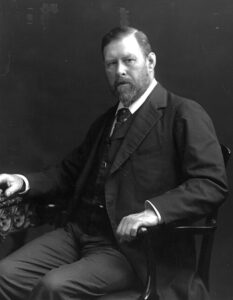
Born November 8, 1847 | Dublin, Ireland
Few fictional characters are as recognizable as Count Dracula. The mysterious vampire has appeared in countless books, films, and stage productions. But the man who created him, Irish author Bram Stoker, led a rather interesting life of his own.
Abraham Stoker, better known as Bram Stoker, was born in Dublin on November 8, 1847. He attended Trinity College, where he studied mathematics, and later worked in the Irish Civil Service. Writing wasn’t initially his only occupation.
In 1878, Stoker moved to London to become business manager of the Lyceum Theatre, working alongside the celebrated Victorian actor Sir Henry Irving. He held that position for 27 years. The job brought him into contact with many of the writers, actors, and artists of the period and gave him opportunities to travel.
The Making of Dracula
Published on May 26, 1897, Dracula was the result of years of reading and research. Stoker drew upon folklore, travel books, history, and popular interest in the supernatural to create his now-famous vampire.
One of the more interesting details about the novel is that Stoker never visited Transylvania, the region that became Count Dracula’s home. Instead, he relied on books, maps, and historical accounts to bring this setting to life.
Stoker’s visit to Whitby, a seaside town in Yorkshire, England, in 1890 also helped shape the novel’s setting. Its dramatic coastline, the ruins of Whitby Abbey, and the old churchyard overlooking the sea all became part of the story’s atmosphere. Readers familiar with the novel may recognize Whitby as the setting for some of its most memorable scenes.
Stoker also chose an unusual way to tell his story. Rather than telling the story from a single point of view, he constructed the novel from diary entries, letters, newspaper reports, and other documents. Readers discover the mystery piece by piece, following characters as they try to understand the terrifying events happening around them.
A Legacy That Lives On
Stoker wrote other novels and short stories throughout his career, but none achieved the recognition of Dracula. The book helped shape modern vampire fiction and has inspired generations of writers, filmmakers, and storytellers.
Bram Stoker died in London on April 20, 1912, but his most famous creation has proved remarkably enduring. More than a century after its publication, Dracula remains a classic of Gothic literature, continuing to attract new generations of readers and audiences.
Whether you enjoy classic horror, Gothic literature, or simply a well-told story, Dracula is a novel worth discovering, or rediscovering. And if you’ve only encountered Dracula in the movies, the original book may hold a few surprises.
Further Reading and Sources
Bram Stoker Estate, biography
The Making of Dracula
Dictionary of Irish Biography, Bram Stoker
Comments are closed.